How to Have Good Conversations
Strategies for good conversations.
Intentions1
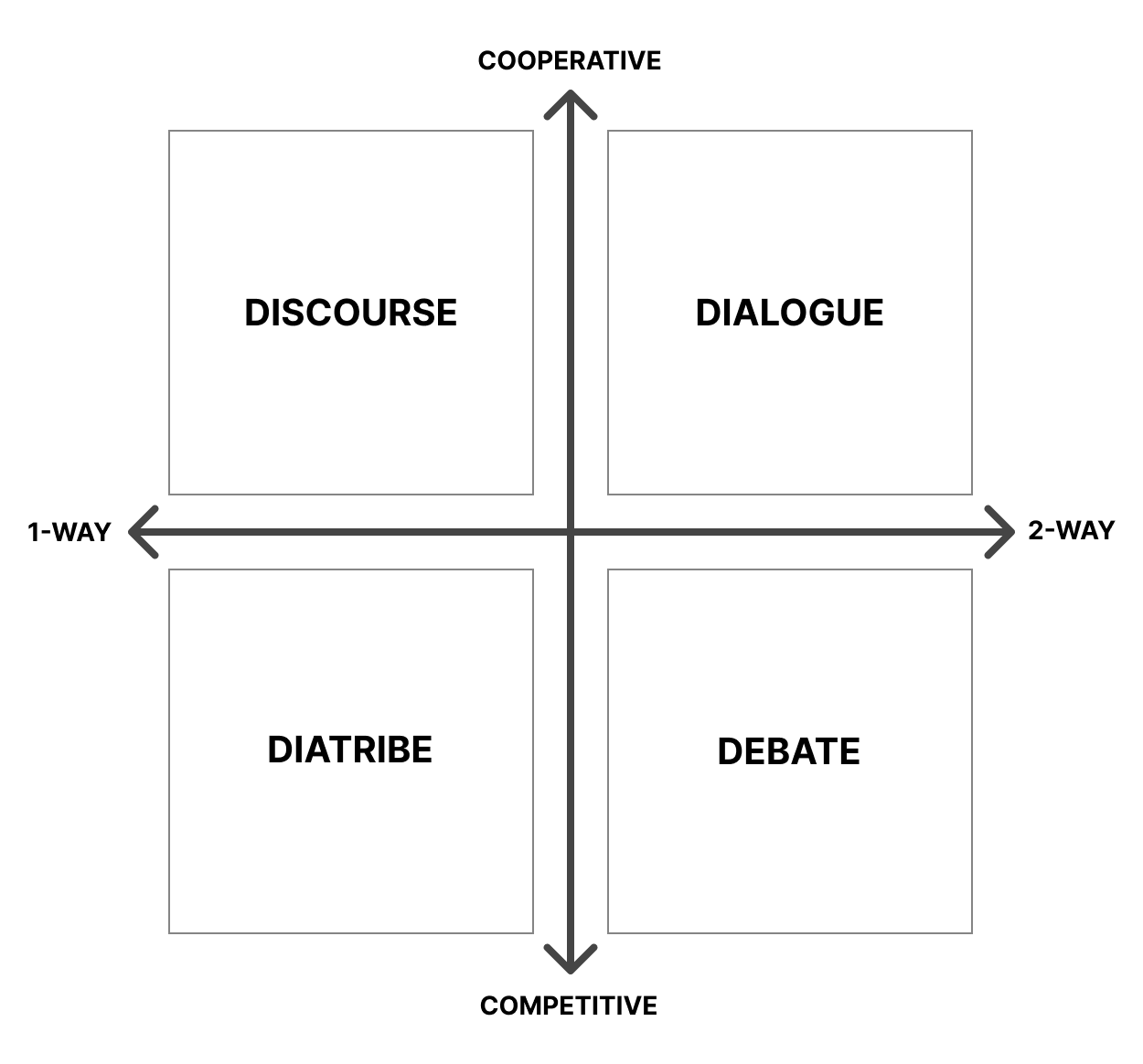
- Be mindful of the type of conversation, even as it shifts and evolves.
- The connection (relationship) matters far more than the content that flows through it.
- Each communication is an opportunity to strengthen and develop the bandwidth and integrity of the connection (relationship).
- If there is no mutual respect, it probably doesn't make sense to engage (or continue to engage).
- Virtues and values to keep top of mind: kindness, generosity, sincerity, earnestness, care, honesty, integrity, humility, curiosity, friendliness, open-mindedness, rigor, compassion, forgiveness, loyalty, impeccability, thoughtfulness, consideration, and above all, love.
Listening
- Employ Rule Omega (and disengage with those who seek to weaponize this concept).
- Assume everyone is trying to express something meaningful and listen to isolate the signal from the noise.
- If it's worth engaging, it must be worth listening through possible grievance-induced exaggerations and distortions to find meaningful truths.
- Listen to steelman the other persons position.
- Tacit knowledge (lived experience) can be hard to articulate. Listening well and asking questions can help elucidate it.
Speaking
- Speaking is not the same as communicating. If the message you intend is not received, you are speaking without communicating. Take responsibility to communicate effectively.
- Use language that engenders openness rather than defensiveness.
- Do not use absolutes (always, never, the reality is…) as they come across as power plays.
- Do not entangle important points with subtle criticisms such that it is impossible for the other person to accept the point without losing face.
- Avoid attitudes of righteousness, superiority, dismissiveness, overconfidence, and indifference.
- Beware emotive (Russell's) conjugation.
- Slow down (especially when things get hot). Take the time to formulate your speech with clarity and precision.
- Admit ignorance of words and concepts you do not understand and ask for clarification.
- Give credit rather than seek it.
Conversational Traps
- Throwing aside your intentions when things get hot.
- Ad hominem attacks.
- Strawmanning.
- Mistaking and rationalizing poor behavior for passion.
- Justifying poor behavior because the other person's views are "bad" (and they deserve it).
- Using humor to insult the other with plausible deniability.
- Thinking about what you're going to say when the other person is talking.
Footnotes
-
Almost all principles on this page are (edited) from "A few guidelines that tend to support the quality of dialogue" by Daniel Schmachtenberger. ↩